2 Peter 2
False Teachers and Their Destruction
1But there were also false prophets among the people, just as there will be false teachers among you. They will secretly introduce destructive heresies, even denying the sovereign Lord who bought them—bringing swift destruction on themselves. 2Many will follow their shameful ways and will bring the way of truth into disrepute. 3In their greed these teachers will exploit you with stories they have made up. Their condemnation has long been hanging over them, and their destruction has not been sleeping.
At our church we are currently in the middle of a sermon series on 2 Peter. Peter, if you notice, does not mince his words. He calls a spade a spade, in no uncertain terms. You should never be left in any confusion as to where you are with Peter!
In this case false teachers are addressed and condemned in the strongest terms possible throughout this book. This is particularly pertinent when you consider the times we are in right now where, more than ever, so many are bringing the truth into disrepute.
In his latest sermon, our priest Jonathan addressed the 19th century naturalism that underpins what passes for theological thought in much of the Anglican Church of Canada and many other churches. I shall quote you just a little bit here (the full text can be found on this page):
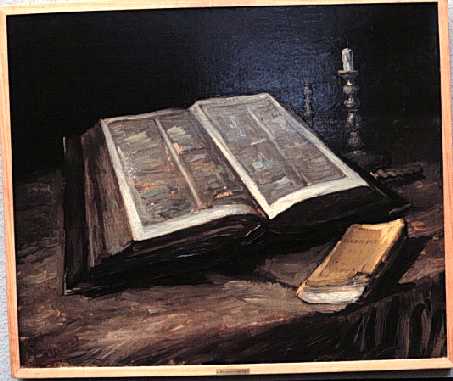
Above is a reproduction of a painting by Vincent Van Gogh, which he composed in 1885. You will notice that there are two books. The larger of the two is the Bible. The other book is entitled: La joie de vivre (Joy of Life) by Emile Zola. Zola was the leading French novelist in the latter part of the 19th century. In 1884 he wrote La Joie De Vivre. It was part of a series of twenty novels he wrote rooted in a philosophical school called Naturalism. Zola helped establish this school.
In summary naturalism taught:
Individual characters were seen as helpless products of heredity and environment, motivated by strong instinctual drives from within and harassed by social and economic pressures from without. As such, they had little will or responsibility for their fates, and the prognosis for their “cases” was pessimistic at the outset.
What do you think Van Gogh was attempting to do by juxtaposing the Bible with Zola’s La Joie de Vivre? I think he was illustrating what was happening in late 19th century intellectual thought. Although the Bible was still open, it was no longer being illuminated. You will notice that the candle is not burning. Rather than the teaching of the Bible guiding life, it was now philosophies, like naturalism, that were in the foreground of intellectual thought.
Well if that was the case in 1885, I would suggest that in our own day we are facing something similar within the Anglican Church of Canada. Philosophies like naturalism are shaping our theological thought and moral conduct. And it is for this reason that our Communion is currently in crisis.
With these thoughts in mind I was very interested to read Kendall Harmon’s thoughts on Episcopal universalism, and how it seeks to change the very essence of what the Bible teaches. Read it all here – it is well worth the read.
You see, naturalism naturally leads onto theological universalism. If we are indeed ‘helpless products of heredity and environment’, then there can really be no sin, Jesus’ death therefore must have had another purpose (just a good example, perhaps?), and all will be well in the end for everybody. There can be no hell, for there are really no choices anyway.
All this is to illustrate what the current struggle in the Anglican (and indeed other churches) is all about. Many folk would like to reframe this debate in terms of homophobia and bigotry, accusing us of both. While indeed homosexual blessing and marriage is currently the headline presenting issue, that is all that it is.
In reality, the struggle over the Bible passages on homosexuality should really point us to a much deeper problem of the theological naturalism and universalism that currently infects our church. This is our struggle, and it is not against flesh and blood, but against ideologies, against rulers, principalities and powers.
It is not without irony that two of the verses excluded in the new, improved Episcopal lectionary are these from Revelation 21:
18: I warn every one who hears the words of the prophecy of this book: if any one adds to them, God will add to him the plagues described in this book,
19: and if any one takes away from the words of the book of this prophecy, God will take away his share in the tree of life and in the holy city, which are described in this book.
This is a warning that we should not take lightly! The scriptures should be treated with the deepest reverence, for these are the words that lead us to the Word of God – Jesus Christ himself!
You know the ideology is suspect when, rather than allowing the Bible to inform the ideology, we allow the ideology to subvert the Bible. And that is exactly what is happening in our age, and in our day. False teachers abound, twisting the scripture to their own desire, telling itching ears what they want to hear. In so doing, they lead both themselves and their adherents on the broad, easy, comfortable road that leads down to the outer darkness, the dark beyond all dark.
Our task, at this time, is to stand firm against this tide of heresy – and to bring the great Light of Christ into this dark world. Know that the gates of hell never cease in their assault on the Church. Know also that the gates of hell never prevail – for Jesus Christ is Lord!